Computer Vision & AR
AR Remote Assistance for Field Technicians
Built an AR platform where remote experts draw annotations on live video, and those drawings stay glued to real-world objects even when the camera moves. Used C++ and OpenCV to implement SIFT feature tracking with 90% re-detection accuracy.
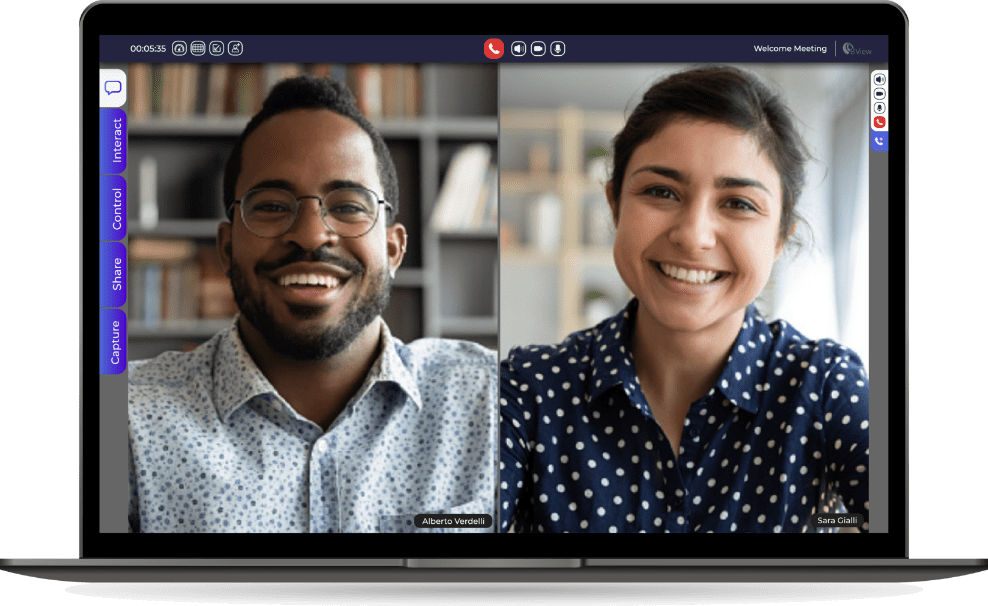
Field technicians repairing industrial equipment often need expert guidance, but flying an expert to every job site is expensive. I built a system where remote experts can watch the technician's camera feed and draw annotations (circles, arrows, labels) that stay physically anchored to real-world objects, even as the technician moves around.
01 / The problem
Drawings that stick to the real world
Here's the scenario: A technician is looking at a broken valve. A remote expert watches through the camera and draws a red circle around the specific bolt that needs tightening. The technician then moves the camera to get a better angle. The red circle needs to stay on that exact bolt, not drift away or disappear.
This sounds simple until you realize cameras move, lighting changes, objects get occluded by hands or tools, and everything is in constant motion. You can't just overlay a static image - you need to track the physical object across video frames in real-time, with sub-100ms latency, on a mobile device or smart glasses.
02 / How I solved it
SIFT feature tracking in C++
I implemented the tracking engine in C++ using OpenCV's SIFT (Scale-Invariant Feature Transform) algorithm. Here's how it works: When the expert draws an annotation, we extract "keypoints" from that region of the image - distinctive points like corners, edges, and texture patterns. We store these keypoints along with the annotation.
On each new video frame, we extract keypoints again and match them against the stored ones. If we find enough matches (at least 10-15), we can compute where the annotated object has moved to, and we reposition the annotation accordingly. This is called "feature correspondence" - we're matching the same physical features across different frames.
The tricky part: SIFT is computationally expensive. Running it on every frame of a 30fps video stream on a mobile device would melt the battery. I implemented a hybrid approach: use SIFT for the initial tracking, then fall back to cheaper optical flow for subsequent frames, and only re-run SIFT when tracking confidence drops. This kept CPU usage under 15% on mid-range Android devices.
03 / The results
90% re-detection accuracy
We tested the system in real factory environments with technicians actually using it for repairs. The key metric: if a technician moved the camera away from an annotated object and then back to it, could the system re-detect the object and restore the annotation? We achieved 90% re-detection accuracy across 500+ test scenarios.
The 10% failure cases were usually extreme conditions: very low light, highly reflective surfaces (like polished metal), or objects with no distinctive texture (like a plain white wall). For these cases, I added a fallback: the system would prompt the expert to re-draw the annotation.
Performance: Session initialization time dropped by 40% (from 8 seconds to 5 seconds) by optimizing the WebRTC handshake and pre-warming the OpenCV engine. Connection failures dropped by 30% by implementing automatic reconnection with exponential backoff.
04 / The architecture
Real-time video pipeline
The video streaming stack: WebRTC for peer-to-peer video between technician and expert, OpenVidu as the signaling server, and Kurento as the media server for recording and processing. The C++ tracking engine runs on the technician's device, processing each frame locally (we can't send every frame to the server for processing - that would add too much latency).
For smart glasses (RealWear, Microsoft HoloLens), I wrote Kotlin integrations that hook into the glasses' camera feed and overlay the annotations using ARKit (iOS) or ARCore (Android) for additional spatial tracking. This gives us sub-centimeter accuracy when the device has AR capabilities, versus the ~5cm accuracy of pure SIFT tracking.
The whole system had to handle multiple failure modes gracefully: network drops (annotations should reappear when connection is restored), device crashes (expert should be able to redraw quickly), and battery saving (tracking should pause when the device is stationary).
Evidence & further reading